
banner
#TheUtilityOfForce The Utility of Force
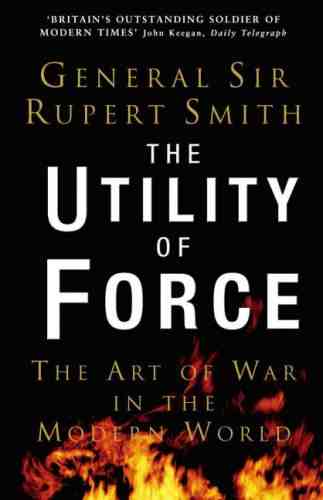
The Utility of Force: The Art of War in the Modern World is a treatise on modern warfare written by General Sir Rupert Smith and published in 2005. Smith is a retired general who spent 40 years in the British Army; he commanded the 1st Armoured Read More..
by General Sir Rupert Smith
Ratings
Ratings 0
Likes
Likes 0
Reviews
Reviews 0
HASH INFO
Review# tag TheUtilityOfForce
Review# tag
Hash title The Utility of Force
Hash title
Description The Utility of Force: The Art of War in the Modern World is a treatise on modern warfare written by General Sir Rupert Smith and published in 2005. Smith is a retired general who spent 40 years in the British Army; he commanded the 1st Armoured Division in the First Gulf War and served as General Officer Commanding Northern Ireland at the end of the Troubles. He was motivated to write the book by his experiences in the Balkans. He commanded the United Nations Protection Force (UNPROFOR) in Bosnia from 1995 to 1996, during which time the Srebrenica massacre occurred and the capital, Sarajevo, was under siege by Serb forces. Smith was instrumental in the lifting of the siege by arranging for NATO air strikes and an artillery barrage. This enabled a ground assault by Bosnian and Croatian forces that ended the siege and led to the Dayton Agreement. Smith's second involvement with the Balkans was in 1999 during the Kosovo War, when he was serving as NATO's Deputy Supreme Allied Commander Europe, overseeing air strikes against Serb targets.Smith's thesis, and the central theme of The Utility of Force, is that the world entered a new paradigm of conflict at the end of the 20th and beginning of the 21st centuries, which he calls "war amongst the people", and that Western, industrialised armies are ill-suited to the new style of warfare. The defining characteristics of "war amongst the people" are that conflicts tend to be timeless, more political in nature, and fought between parties that are part of, and in amongst, the civilian population rather than between uniformed armies on a battlefield. To prove his theory, Smith provides a detailed history starting with Napoleon, who invented what Smith calls "industrial warfare"—the paradigm in which the entire resources of the nation were mustered and which culminated in the two world wars. In the second half of the book, Smith states that the advent of nuclear weapons rendered industrial warfare obsolete, but that Western governments and generals refused to acknowledge the new paradigm, which led to several significant defeats in the second half of the 20th century. He provides six themes which characterise modern conflicts and proceeds to analyse each in detail, before dedicating his final chapter to his reflections on his command in Bosnia. He concedes that he did not foresee the Srebenica massacre, but criticises UNPROFOR, believing that it was not in a position to act even had the massacre been foreseen and that it had no strategy for effectively intervening in the war. In his conclusion, Smith argues that military force is only part of the solution in modern conflicts, and that it must be combined with political initiatives which together will subdue but not necessarily end the conflict.The Utility of Force was broadly praised by reviewers on both sides of the Atlantic. It was compared favourably with Carl von Clausewitz's treatise On War and American reviewers felt that it contained important lessons for the United States military. Smith was criticised for over-emphasising the paradigm shift, with several reviewers observing that conventional wars are still fought and that the threat of such wars still exists, and for drawing too clear a distinction between "war amongst the people" and conventional war, particularly with his opening sentence "war no longer exists". Reviewers also felt that Smith under-emphasised the extent to which "war amongst the people" has always existed. Nonetheless, reviewers praised Smith's analysis of modern war and recommended that The Utility of Force ought to be read by politicians and military officers.
Description
Created By Admin
DETAILS
Name The Utility of Force: The Art of War in the Modern World
Name
Authors General Sir Rupert Smith
Authors
Translator
Translator
Genre Military history
Genre
Series
Series
Number in series
Number in series
Language English
Language
Country United Kingdom
Country
PUBLISH
Story timeline
Story timeline
Pages 428
Pages
Media_type
Media_type
Isbn 9780713998368
Isbn
Oclc
Oclc
Publisher Allen Lane
Publisher
RELEASE
Pub_date 2005
Pub_date
Release_date
Release_date
Writing
Style of narration
Portraying the concept
Language & literature
Castings & characters
Overall rating
No reviews available for #TheUtilityOfForce, Do you know The Utility of Force?, Please add your review and spread the good things.
No images available.
MORE INFO
Ratings
No ratings yet.
Feature Ratings
No Feature ratings yet.
Popularity
Reaches
No data available now.
Ranks
This #hashtag is not ranked yet.
×