
banner
#NovelasEjemplares Novelas ejemplares
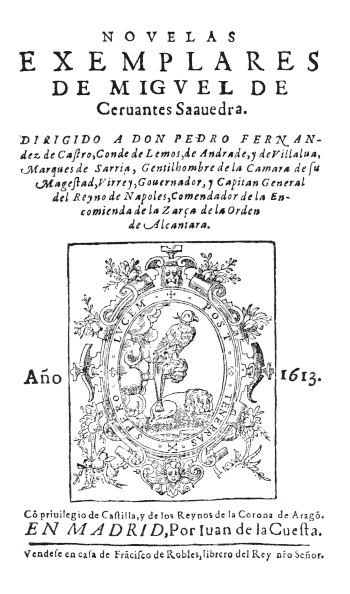
Novelas ejemplares ("Exemplary Novels") is a series of twelve novellas that follow the model established in Italy, written by Miguel de Cervantes between 1590 and 1612. The collection was printed in Madrid in 1613 by Juan de la Cuesta, and received Read More..
by Miguel de Cervantes
Ratings
Ratings 0
Likes
Likes 0
Reviews
Reviews 0
HASH INFO
Review# tag NovelasEjemplares
Review# tag
Hash title Novelas ejemplares
Hash title
Description Novelas ejemplares ("Exemplary Novels") is a series of twelve novellas that follow the model established in Italy, written by Miguel de Cervantes between 1590 and 1612. The collection was printed in Madrid in 1613 by Juan de la Cuesta, and received well in the wake of the first part of Don Quixote.Cervantes boasted in his foreword to have been the first to write novelas in the Spanish language:My genius and my inclination prompt me to this kind of writing; the more so as I consider (and with truth) that I am the first who has written novels in the Spanish language, though many have hitherto appeared among us, all of them translated from foreign authors. But these are my own, neither imitated nor stolen from anyone; my genius has engendered them, my pen has brought them forth, and they are growing up in the arms of the press.The novellas are usually grouped into two series: those characterized by an idealized nature and those of a realistic nature. Those idealized in nature, which are the closest to the Italian models, are characterized by plots dealing with amorous entanglements, by improbable plots, by the presence of idealized characters and psychological development, and the low reflection of reality. They include: El amante liberal, Las dos doncellas, La española inglesa, La señora Cornelia and La fuerza de la sangre. These were the most popular of the novellas at the time. The realistic in nature cater to the descriptions of realistic characters and environments, with intentional criticism in many cases. The realistic in nature are the best-known stories today: Rinconete y Cortadillo, El licenciado Vidriera, La gitanilla, El casamiento engañoso (which leads directly into the fantasy El coloquio de los perros), and La ilustre fregona. However, the separation between the two groups is not sharp and elements of the idealistic may be found in some of the realistic novels.Since there are multiple versions of two of these stories, it is believed that Cervantes introduced some variations in these novels for moral, social and aesthetic purposes (hence the name 'exemplary'). The more primitive versions were found in the manuscript, now lost, called by the name of its one-time possessor, Porras de la Cámara, a miscellaneous collection of various literary works which include a novel usually attributed to Cervantes, La tía fingida. On the other hand, some short stories are also embedded in Don Quixote, such as El curioso impertinente or Historia del cautivo, and where a character possesses a manuscript of Rinconete y Cortadillo, unpublished at the time (1605).
Description
Created By Admin
DETAILS
Name Novelas ejemplares
Name
Authors Miguel de Cervantes
Authors
Translator
Translator
Genre
Genre
Series
Series
Number in series
Number in series
Language Spanish
Language
Country Spain
Country
PUBLISH
Story timeline
Story timeline
Pages
Pages
Media_type
Media_type
Isbn
Isbn
Oclc
Oclc
Publisher Juan de la Cuesta
Publisher
RELEASE
Pub_date
Pub_date
Release_date
Release_date
Writing
Style of narration
Portraying the concept
Language & literature
Castings & characters
Overall rating
No reviews available for #NovelasEjemplares, Do you know Novelas ejemplares?, Please add your review and spread the good things.
No images available.
MORE INFO
Ratings
No ratings yet.
Feature Ratings
No Feature ratings yet.
Popularity
Reaches
No data available now.
Ranks
This #hashtag is not ranked yet.
×