
banner
#JinPingMei Jin Ping Mei
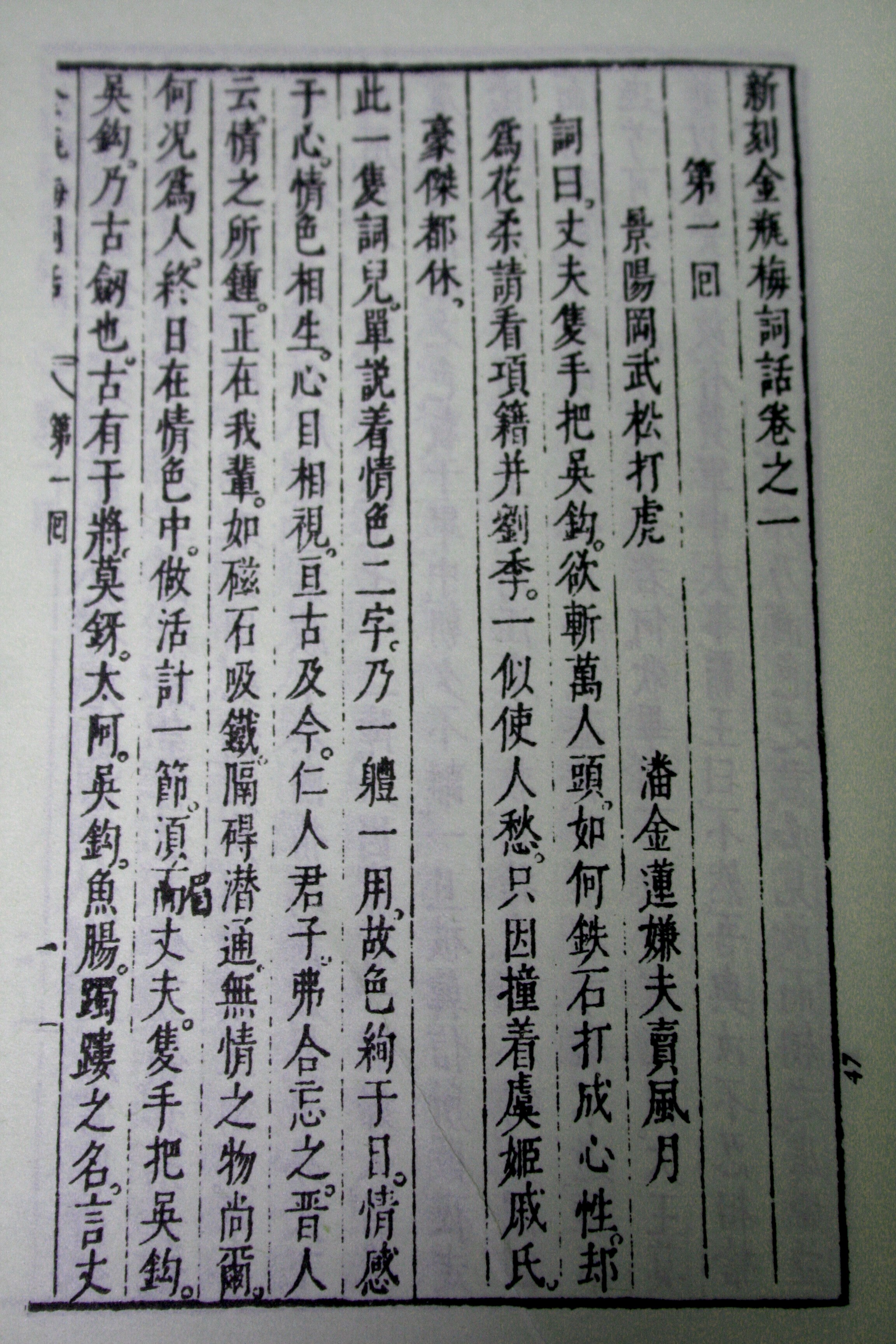
Jin Ping Mei () — translated into English as The Plum in the Golden Vase or The Golden Lotus — is a Chinese naturalistic novel composed in vernacular Chinese during the late Ming Dynasty (1368–1644). The anonymous author took the pseudonym Lanling Read More..
by Lanling Xiaoxiao Sheng ("The Scoffing Scholar of Lanling", pseudonym)
Ratings
Ratings 0
Likes
Likes 0
Reviews
Reviews 0
HASH INFO
Review# tag JinPingMei
Review# tag
Hash title Jin Ping Mei
Hash title
Description Jin Ping Mei () — translated into English as The Plum in the Golden Vase or The Golden Lotus — is a Chinese naturalistic novel composed in vernacular Chinese during the late Ming Dynasty (1368–1644). The anonymous author took the pseudonym Lanling Xiaoxiao Sheng (蘭陵笑笑生), "The Scoffing Scholar of Lanling,"Michael Dillon, China: A Cultural and Historical Dictionary, Routledge, 1998, ISBN 0-7007-0439-6, pp.163-164 and his identity is otherwise unknown (the only clue being that he hailed from Lanling in present-day Shandong).Lu (1923) p.408 The novel circulated in manuscript as early as 1596, and may have undergone revision up to its first printed version in 1610. The most widely read version, edited and published with commentaries by Zhang Zhupo in 1695, unfortunately accepted the deletion and rewriting of many passages.The graphically explicit depiction of sexuality garnered the novel a notoriety in China akin to Fanny Hill and Lolita in English literature, but critics such as the translator David Tod Roy see a firm society structure which exacts retribution for the sexual libertinism of the central characters.Jin Ping Mei takes its name from the three central female characters — Pan Jinlian (潘金蓮, whose given name means "Golden Lotus"); Li Ping'er (李瓶兒, given name literally means, "Little Vase"), a concubine of Ximen Qing; and Pang Chunmei (龐春梅, "Spring plum blossoms"), a young maid who rose to power within the family. Chinese critics see each of the three Chinese characters in its title as symbolizing an aspect of human nature, such as mei (梅), plum blossoms, is metaphoric for sexuality.Princeton University Press, in describing the Roy translation, calls the novel "a landmark in the development of the narrative art form – not only from a specifically Chinese perspective but in a world-historical context...noted for its surprisingly modern technique" and "with the possible exception of The Tale of Genji (c. 1010) and Don Quixote (1605, 1615), there is no earlier work of prose fiction of equal sophistication in world literature." Princeton University Press Online Catalogue
Description
Created By Admin
DETAILS
Name Jin Ping Mei
Name
Authors Lanling Xiaoxiao Sheng ("The Scoffing Scholar of Lanling", pseudonym)
Authors
Translator
Translator
Genre
Genre
Series
Series
Number in series
Number in series
Language Chinese
Language
Country China
Country
PUBLISH
Story timeline
Story timeline
Pages
Pages
Media_type Print
Media_type
Isbn
Isbn
Oclc
Oclc
Publisher
Publisher
RELEASE
Pub_date
Pub_date
Release_date
Release_date
Writing
Style of narration
Portraying the concept
Language & literature
Castings & characters
Overall rating
No reviews available for #JinPingMei, Do you know Jin Ping Mei?, Please add your review and spread the good things.
No images available.
MORE INFO
Ratings
No ratings yet.
Feature Ratings
No Feature ratings yet.
Popularity
Reaches
No data available now.
Ranks
This #hashtag is not ranked yet.
×