
banner
#EitherOr Either/Or
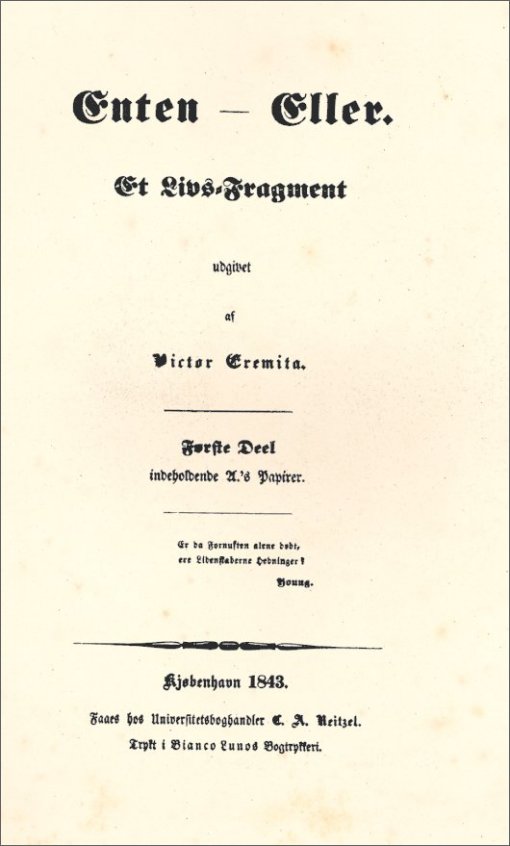
Either/Or (Danish: Enten – Eller) is the first published work of the Danish philosopher Søren Kierkegaard. Appearing in two volumes in 1843 under the pseudonymous authorship of Victor Eremita (Latin for "victorious hermit") it outlines a theory of Read More..
Ratings
Ratings 0
Likes
Likes 0
Reviews
Reviews 0
HASH INFO
Review# tag EitherOr
Review# tag
Hash title Either/Or
Hash title
Description Either/Or (Danish: Enten – Eller) is the first published work of the Danish philosopher Søren Kierkegaard. Appearing in two volumes in 1843 under the pseudonymous authorship of Victor Eremita (Latin for "victorious hermit") it outlines a theory of human development in which consciousness progresses from an essentially hedonistic, aesthetic mode to one characterized by ethical imperatives arising from the maturing of human conscience.Either/Or portrays two life views, one consciously hedonistic, the other based on ethical duty and responsibility. Each life view is written and represented by a fictional pseudonymous author, with the prose of the work reflecting and depending on the life view being discussed. For example, the aesthetic life view is written in short essay form, with poetic imagery and allusions, discussing aesthetic topics such as music, seduction, drama, and beauty. The ethical life view is written as two long letters, with a more argumentative and restrained prose, discussing moral responsibility, critical reflection, and marriage.Kierkegaard, Søren. The Essential Kierkegaard, edited by Howard and Edna Hong. Princeton, ISBN 0-691-01940-1 The views of the book are not neatly summarized, but are expressed as lived experiences embodied by the pseudonymous authors. The book's central concern is the primal question asked by Aristotle, "How should we live?"Warburton, Nigel. Philosophy: The Classics, 2nd edition. Routledge, ISBN 0-415-23998-2 His book was certainly informed by Epictetus; "Consider first, man, what the matter is, and what your own nature is able to bear. If you would be a wrestler, consider your shoulders, your back, your thighs; for different persons are made for different things. Do you think that you can act as you do and be a philosopher, that you can eat, drink, be angry, be discontented, as you are now? You must watch, you must labor, you must get the better of certain appetites, must quit your acquaintances, be despised by your servant, be laughed at by those you meet; come off worse than others in everything—in offices, in honors, before tribunals. When you have fully considered all these things, approach, if you please—that is, if, by parting with them, you have a mind to purchase serenity, freedom, and tranquillity. If not, do not come hither; do not, like children, be now a philosopher, then a publican, then an orator, and then one of Caesar’s officers. These things are not consistent. You must be one man, either good or bad. You must cultivate either your own reason or else externals; apply yourself either to things within or without you—that is, be either a philosopher or one of the mob." His motto comes from Plutarch, "The deceived is wiser than one not deceived.”Søren Kierkegaard, Judge William, Stages on Life's Way p. 88, 119-120 HongThe aesthetic is the personal, subjective realm of existence, where an individual lives and extracts pleasure from life only for his or her own sake. In this realm, one has the possibility of the highest as well as the lowest. The ethical, on the other hand, is the civic realm of existence, where one's value and identity are judged and at times superseded by the objective world. In simple terms, one can choose either to remain oblivious to all that goes on in the world, or to become involved. More specifically, the ethic realm starts with a conscious effort to choose one's life, with a choice to choose. Either way, however, an individual can go too far in these realms and lose sight of his or her true self. Only faith can rescue the individual from these two opposing realms. Either/Or concludes with a brief sermon hinting at the nature of the religious sphere of existence, which Kierkegaard spent most of his publishing career expounding upon. Ultimately, Kierkegaard's challenge is for the reader to "discover a second face hidden behind the one you see"Either/Or Part I, Swenson, p. 172-173, Goethe with Special Consideration of His Philosophy by Paul Cairus, 1915 p. 223 in him/herself first, and then in others. Johann Goethe said the same.
Description
Created By Admin
DETAILS
Name Either – Or. A Life Fragment edited by Victor Eremita
Name
Authors Søren Kierkegaard
Authors
Translator
Translator
Genre Philosophy , philosophical novel
Genre
Series First authorship (Pseudonymous)
Series
Number in series
Number in series
Language Danish
Language
Country Denmark
Country
PUBLISH
Story timeline
Story timeline
Pages 800+
Pages
Media_type
Media_type
Isbn
Isbn
Oclc
Oclc
Publisher University bookshop Reitzel, Copenhagen
Publisher
RELEASE
Pub_date February 20, 1843
Pub_date
Release_date February 20, 1843
Release_date
Writing
Story
Style of narration
Language & literature
Castings & characters
Overall rating
No reviews available for #EitherOr, Do you know Either/Or?, Please add your review and spread the good things.
No images available.
MORE INFO
Ratings
No ratings yet.
Feature Ratings
No Feature ratings yet.
Popularity
Reaches
No data available now.
Ranks
This #hashtag is not ranked yet.
×