
banner
#AmadsDeGaula Amadís de Gaula
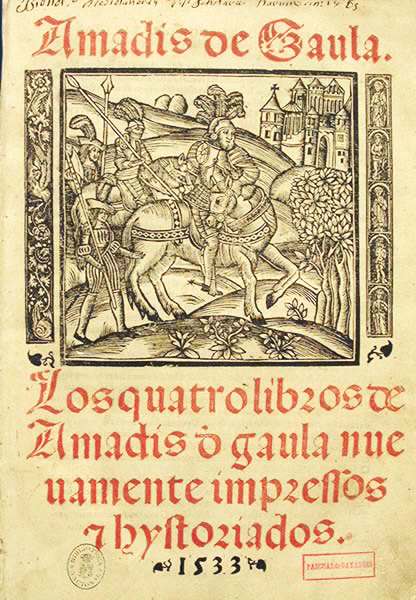
Amadís de Gaula (original Old Spanish and Galician-Portuguese spelling; , ; , ) is a landmark work among the chivalric romances which were in vogue in sixteenth-century Spain, although its first version, much revised before printing, was written at Read More..
by Garci Rodríguez de Montalvo (printed version)
Ratings
Ratings 0
Likes
Likes 0
Reviews
Reviews 0
HASH INFO
Review# tag AmadsDeGaula
Review# tag
Hash title Amadís de Gaula
Hash title
Description Amadís de Gaula (original Old Spanish and Galician-Portuguese spelling; , ; , ) is a landmark work among the chivalric romances which were in vogue in sixteenth-century Spain, although its first version, much revised before printing, was written at the onset of the 14th century.The earliest surviving edition of the known text, by Garci Rodríguez de Montalvo (not Ordóñez de Montalvo), was published in Zaragoza in 1508, although almost certainly there were earlier printed editions, now lost.Daniel Eisenberg and Maricarmen Marín Pina, Bibliografía de los libros de caballerías castellanos, 2000, It was published in four books in Castilian, but its origins are unclear: The narrative originates in the late post-Arthurian genre and had certainly been read as early as the 14th century by the chancellor Pero López de Ayala as well as his contemporary Pero Ferrús.Montalvo himself confesses to have amended the first three volumes, and to be the author of the fourth. Additionally, in the Portuguese Chronicle by Gomes Eannes de Azurara (1454), Amadis is attributed to Vasco de Lobeira, who was knighted after the Battle of Aljubarrota (1385). However, although other sources claim that the work was, in fact, a copy of one João de Lobeira, not troubadour Vasco de Lobeira, and that it was a translation into Castilian Spanish of an earlier work, probably from the beginning of the 14th century, no primitive version in the original Portuguese is known. The inspiration for the "Amadis de Gaula" appears to be the blocked marriage of Infanta Constanza of Aragon with Henry of Castile in 1260 (See Juan Manuel's Libro de las Armas of 1335), as blocked was also Oriana's marriage to Amadis. A more recent, minority opinion attributes "Amadis" to Henry of Castile and León, due to evidence linking his biography with the events in "Amadis". Henry of Castile died in 1305.In his introduction to the text, Garci Rodríguez de Montalvo explains that he has edited the first three books of a text in circulation since the 14th century. Montalvo also admits to adding a fourth as yet unpublished book as well as adding a continuation (Las sergas de Esplandián), which he claims was found in a buried chest in Constantinople and transported to Spain by a Hungarian merchant (the famous motif of the found manuscript).
Description
Created By Admin
DETAILS
Name
Name
Authors Garci Rodríguez de Montalvo (printed version)
Authors
Translator
Translator
Genre
Genre
Series
Series
Number in series
Number in series
Language Old Castilian / Old Portuguese
Language
Country Spain / Portugal
Country
PUBLISH
Story timeline
Story timeline
Pages
Pages
Media_type
Media_type
Isbn
Isbn
Oclc
Oclc
Publisher
Publisher
RELEASE
Pub_date 1304 (first release)1508 (earliest surviving printed book)
Pub_date
Release_date 1304 (first release)1508 (earliest surviving printed book)
Release_date
Writing
Style of narration
Portraying the concept
Language & literature
Castings & characters
Overall rating
No reviews available for #AmadsDeGaula, Do you know Amadís de Gaula?, Please add your review and spread the good things.
No images available.
MORE INFO
Ratings
No ratings yet.
Feature Ratings
No Feature ratings yet.
Popularity
Reaches
No data available now.
Ranks
This #hashtag is not ranked yet.
×